







- Mayor : Dimitrios Karnavos
- Website : www.kallithea.gr
Kallithea is a Greek municipality, situated in the south surrounding of Athens near the Faliro coast and covers almost 4.500 sq.km. It has a population of 100.641 citizens, but it is estimated that more than 250.000 people are living, working or passing by on a daily basis, so it is the most densely populated municipality of Greece, with 21,191 inhabitants/km2.
The Municipality of Kallithea was founded in 1884. It was named “Kallithea” (beautiful view), after the marvellous sea-view provided to its first inhabitants. The first house-plans were designed by the famous German architect Ernst Ziller. The newly founded Municipality of Kallithea decided to adopt Theseus, the most significant hero of ancient Attica, as its emblem. In the circular intaglio constituting Kallithea’s logo, Theseus is depicted lifting the huge rock, under which his father Aigeas had hidden his sword and sandals. The association between Kallithea and Theseus is most probably based on the fact that at the end of his return journey from Crete, the Athenian hero and his men are thought to have landed at the Tzitzifies coast.
Kallithea hosts two universities: the Panteio University of Social and Political Sciences and the Harokopeion University, which are providing us with useful information in many sectors due to their experimental research in areas such as social and economic studies, smart cities, (IT) technology and sustainable growth. Additionally, the historical Sivitanidios Public School of Trades and Vocations is situated in the area. Finally, we are very proud that we host the Centre for Education and Rehabilitation for the Blind (C.E.R.B.), as well as the Lighthouse for the Blind of Greece.
The city of Kallithea has a variety of population groups that settled here from the early 19th century up to nowadays. Most of them are expatriate – refugees who return to Greece from Asia Minor and the coastal areas of the Black Sea as well as expatriate and immigrants from Russia, Czech Republic and other eastern European countries. All these groups have a quite diverse cultural background that gives Kallithea a quite multicultural life.
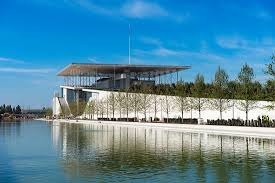
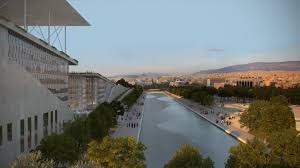
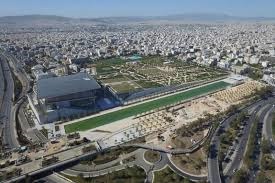
Modern Kallithea is facing many challenges besides the economic crisis, such as the renovation of the coastal front of Faliro in combination with the construction of the unique Metropolitan Park of Culture and Leisure of Attica that will host the National Opera and the National Library of Greece, a donation of the Stavros Niarchos Foundation, (SNFCC) (http://www.snfcc.org/multimedia/videos/) in an area of 170,000m2.
A beacon of sustainability is born out in every aspect of the design – from the Stavros Niarchos Park, which also functions as a green roof for the National Library and Greek National Opera, to the canal which provides anti/flooding protection for the site, to the photovoltaic canopy which produces energy for the needs of the two buildings and contribute to the goal of zero emissions. The Stavros Niarchos Park, which covers 85% of the SNFCC site, will be one of the largest spaces in Athens – welcome news and a vital breath of life to a city with the lowest per capita green space in Europe. The Park is landscaped with indigenous, drought-resistant trees and plants, and its “allées” of shade trees will “sink” CO2 emissions. The Stavros Niarchos Foundation is considered as a valued strategic partner which is providing us with many new green technologies in order to transform Kallithea to a more environment-friendly area.