





- Mayor :Fatiha El Moudni
- Region : Rabat- Salé-Kénitra
- Website : en cours de rénovation
Rabat is the capital of Morocco
The city is on the edge of the Atlantic Ocean, in the North-West of Morocco, 40 km away from Kenitra and 90 km at the North-East of Casablanca. It is separated from the city of Salé at the level of the mouth of Bouregreg. On the administrative level, its territory, of a surface area of 118 km, corresponds to that of the prefecture of Rabat that is made of the urban community of Rabat, one the one hand, divided into 5 districts; and on the other hand the urban community of Touarga, where is located the main royal palace of the country. During the most recent census (2015), the city had 1 972 686 inhabitants, making Rabat the 7th most populated city in the Kingdom. With its suburban area, it is the second biggest conurbation of the country after that of Casablanca. It was founded in 1150 by the Almohad dynasty, which built there a citadel (which became the Kasbah of the Oudayas), a mosque and a residence. It was what we called by then a ribat, a “fortress”. The current name comes from “ribat al fath”, the “camp of victory”. Later, the grandson of Al-Mumim, Ya’qub al-Manur, grew up and completed the building of the city, notably by surrounding it with ramparts. After, it served as a base for military operations in Andalusia.
Administration
The urban municipality of Rabat is divided into 5 districts :
- Hassan
- Ryad
- El-Youssoufia
- Yacoub el-Mansour
- Souissi
Culture and Heritage
World heritage
Since June 2012, a group of sites of the city is registered on the list of the UNESCO World Heritage as cultural goods: the new city (edified at the beginning of the French protectorate in Morocco), the Kasbah of Oudayas, the median, the ramparts and Almohad doors, the sites of Chellah and the mosque Hassan, the mausoleum Mohammed V.
Monuments
- The Kasbah of Oudaïa: ribat overhanging the mouth of the Bou Regreg wadi, where the museum of Oudayas is; the ribat that was first conceived has the national museum of Jewellery.
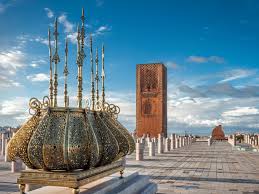
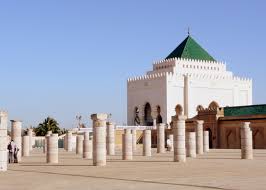
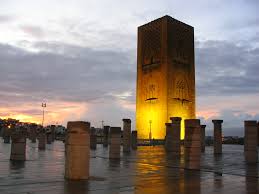
- The Hassan tower, ruins of the mosque that was built by Ya’qub al-Mansur, destroyed at the moment of the Lisbon earthquake in 1755 and the Mausoleum of Mohammed V: where King Mohammed V and his two sons rest, Hassan II and its brother Moulay Abdellah.
- The Saint-Peter Cathedral: Place of Golan, this building, always dedicated to the Catholic cult, was finished in 1930.
- Dâr-El Makhzen: the royal palace and the head office of the government where more than 2000 people live and work. We have access to the palace by a broad esplanade, the “Mechouar”.
- Bar ar-Rouah and the avenue of the Royal armed forces (FAR): the most famous of the monumental doors of Rabat means, according to some, the “door of winds”, according to others, the “door of the return”. From the Almohad period, as Bab Oudaïa is, it surprises with its rich decoration. It used to be the only way to access to Rabat, by a physical way.
- The old medina: bordered to the North by the Bouregreg, protected from the Ocean by the walls of the Kasbah of Oudayas, it is surrounded in the East by the Almohad ramparts, and in the South by the wall of Andalus that separates the new city from the old.
Transport infrastructures
The new bridge Hassan II and the tunnel of Oudayas
To unblock the traffic on the motorway axis linking Salé to Rabat, a new bridge with two times three ways replaced the old bridge Moulay al-Hassan (2*2 ways). This new bridge will thus enable a more fluid traffic on the crossing of the River. Moreover, two tramway lines will cross the Bouregreg River, enabling to ensure the transport of people from Rabat and Salé, but also reducing the number of buses that cross the bridge, which was the main source of traffic jam. The tunnel of Oudayas enables today to reduce the car congestion in the axis going from the bridge Hassan II to the Ocean by passing by an important touristic site of Rabat, the Kasbah of Oudayas. Moreover, this one should enable, thanks to traffic deviation from the Al Marsa avenue towards the tunnel, the concretisation of the project of a pedestrian zone between the Oudayas and the medina of Rabat, which used to be a bustling avenue.
The tramway
The city of Rabat has since May 2011 two tram lines of a total length of 22 km. The lines serve both Salé and Rabat with a North-South axis and a common core of 3 km from the town centre of Rabat to the beginning of Salé, after the crossing of Bouregreg via the Bridge Hassan II. The 41 stations are served by double carriages Alstom Citadis of a total length of 60 m.
The motorway ring road
The ring road is currently being built and will be 41 km long in 2016. It will notably have the highest bridge with shrouds of Africa. This future ring road will enable to put less pressure on the current urban ring road
Trains
The Rabat-City station has been renovated from 2008 to 2010. A high-speed line was planned in the periphery, near Technopolis. It will enable the Moroccan high speed train to link Rabat and Tangier in one hour, and Rabat and Casablanca in half-an-hour.
Bus lines
The conurbation has a network of buses that was reorganised in 2011, with more than 60 lines links cities of Rabat, Salé and Témara.
Universities and research
Rabat is, with Casablanca, the city in which most of the Moroccan universities are, in spite of recent attempts to decentralise higher education. The University Mohamed V, the first university founded after the independence (1957), is today divided into two faculties: the University Mohamed V – Agdal and the University Mohamed V – Souissi.
The University Mohamed V – Agdal welcomes 18 600 students (in 2008) and 5000 of them are in graduate school. It has the oldest engineering school in Morocco and Africa: the Mohammadia school of engineers, founded in 1959 and located in Agdal. The University Mohamed V –Soussi welcomes around 17 000 inhabitants, with 3500 in graduate school. In very different fields: law, economics, health, human and social sciences, education sciences and computer engineering. The national superior school of computing is directly related to the faculty. Many other colleges and public schools are installed in Rabat, such as the national school of architecture, the national institute of communications, the Institute of agronomic and veterinary sciences Hassan II, the national school of mineral industry, the national institute of statistics and applied economics, the Moroccan Academy of diplomatic studies and the international university of Rabat. Besides, there are also many private institutions such as the superior school of management, computing and telecommunication, the superior Institute of applied engineering, the Moroccan school of engineering sciences, the Institute of high studies of management and the SIST British University.